
Largemouth bass are defined by a jaw that extends past the rear of the eye, while smallmouth bass have a jaw that stops at or before the eye. That single anatomical difference signals two completely separate fish with different habitats, behaviors, and ideal fishing approaches. Understanding the largemouth vs smallmouth bass distinction is not just academic. It changes where you fish, what gear you rig, and how you read the water. Whether you are chasing a personal best or preparing for a BAM Trail tournament, knowing which species you are targeting puts you ahead of anglers who treat both fish the same.
What are the key differences between largemouth and smallmouth bass?
The jaw is the fastest field identification tool, but color and body shape confirm the call. Largemouth bass display a green body with a bold horizontal dark stripe running along the lateral line. Smallmouth bass show a bronze or brownish body with vertical dark bars on the sides. Largemouth tend to be deeper bodied and heavier for their length. Smallmouth are more streamlined, built for current and open water.
Size potential separates the two species dramatically. The all-tackle largemouth record stands at 22 lb 4 oz, set in 1932. The smallmouth record is 11 lb 15 oz, set in 1955. That gap reflects real biology. Largemouth grow larger in warm, food-rich environments. Smallmouth top out at a smaller size but punch well above their weight in terms of fight.
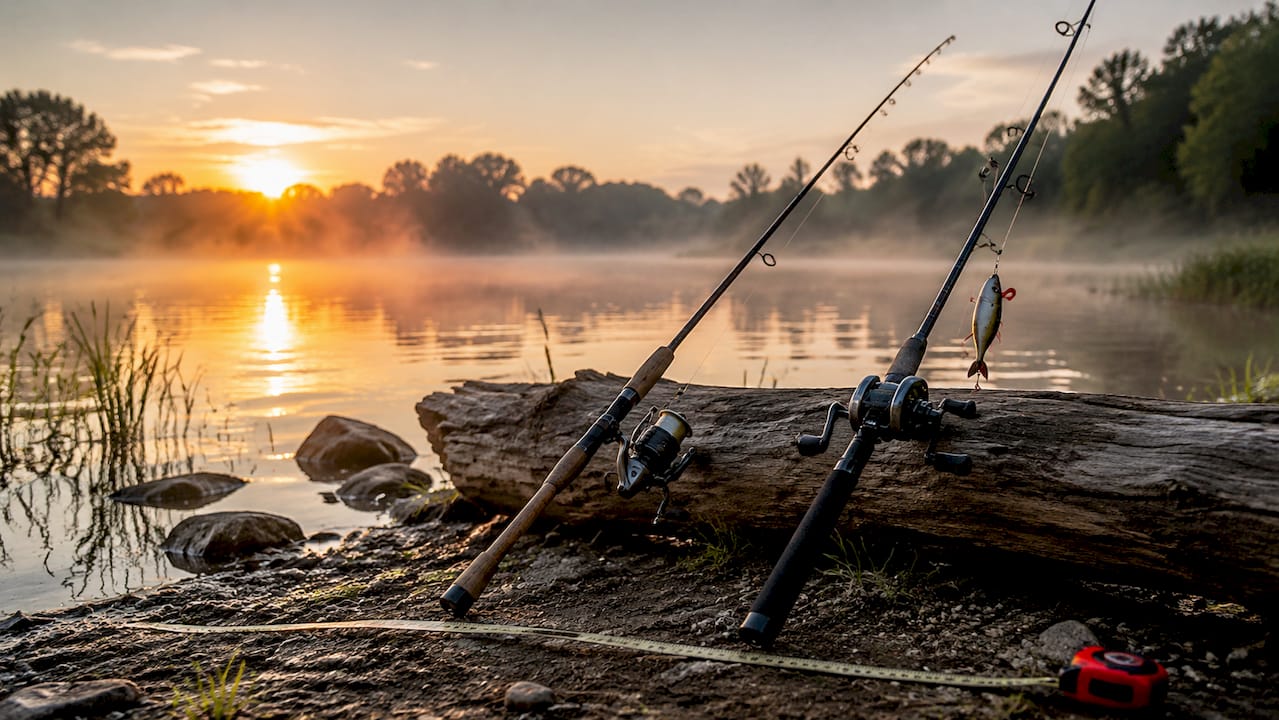
Pro Tip: When you are not sure which species you have on the line, check the jaw before the fish hits the livewell. It takes two seconds and removes all doubt.
Here is a quick side-by-side comparison:
| Feature | Largemouth Bass | Smallmouth Bass |
|---|---|---|
| Jaw extension | Past rear of eye | At or before rear of eye |
| Body color | Green with horizontal stripe | Bronze with vertical bars |
| Record weight | 22 lb 4 oz (1932) | 11 lb 15 oz (1955) |
| Fight style | Powerful, short runs toward cover | Sustained runs, aerial leaps |
| Feeding behavior | Ambush predator near structure | Roaming, current-oriented forager |
Behaviorally, these fish operate on opposite ends of the spectrum. Largemouth are ambush predators that hold tight to cover and wait for prey to come to them. Smallmouth roam actively, using current to intercept baitfish. That behavioral split drives every tactical decision you make on the water.
- Largemouth explode on lures with short, powerful runs toward cover
- Smallmouth fight with sustained runs and frequent aerial leaps
- Smallmouth are considered superior fighters pound-for-pound
- Largemouth rely on ambush; smallmouth rely on speed and endurance
How do habitat preferences differ for each species?
Water temperature is a more reliable guide to finding bass than season alone. Largemouth thrive in 60–75°F water with dense vegetation, submerged timber, and shallow protected pockets. Smallmouth prefer 55–70°F water with rock, gravel, or hard bottom structure. That 5-degree overlap in the middle is where things get interesting on mixed fisheries.
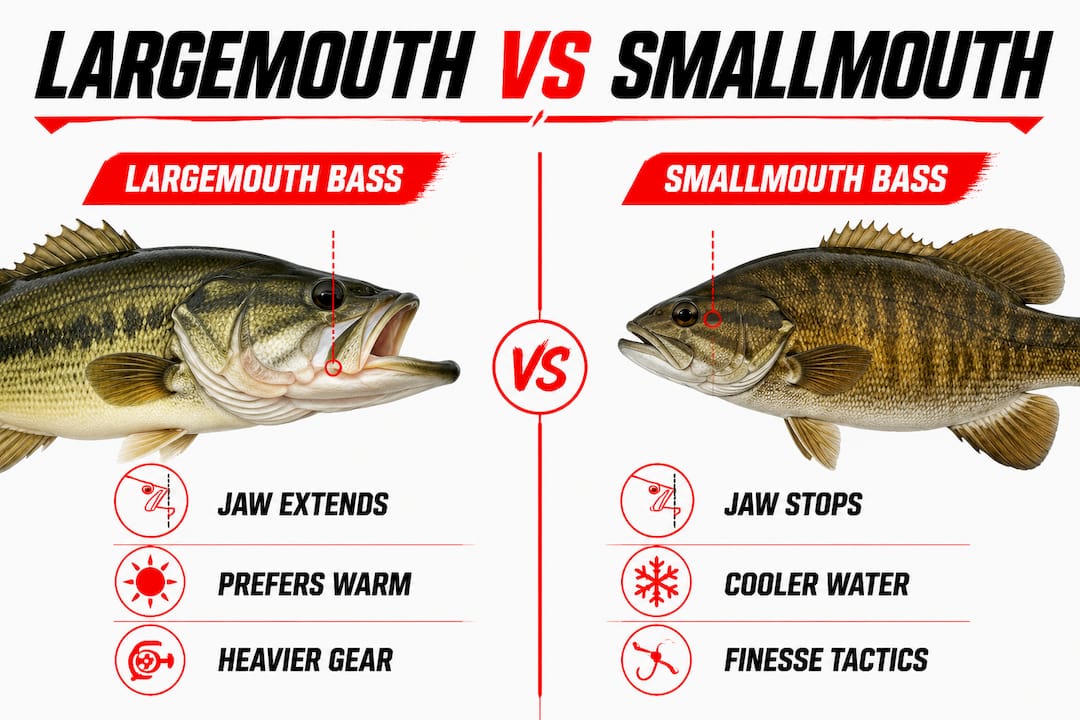
In lakes and reservoirs where both species coexist, they rarely share the same exact spots. Largemouth stay in warmer, shallower areas near cover. Smallmouth push to main-lake points, rocky shoals, and deeper transitions. This spatial separation is called habitat partitioning, and it is one of the most useful concepts for reading water efficiently.
Water clarity matters more for smallmouth than for largemouth. Smallmouth are highly visual predators. They hunt by sight in clear water and will reject a presentation that looks unnatural. Largemouth rely heavily on their lateral line to detect vibrations in murky or stained water, which is why loud, vibrating lures like chatterbaits and crankbaits work so well in heavy cover.
- Largemouth: warm, stained water, vegetation, shallow timber, protected coves
- Smallmouth: cool, clear water, rocky points, gravel flats, main-lake structure
- Water temperature is the primary diagnostic tool for locating each species
- In mixed fisheries, reading water transitions between gravel and cover reveals which species holds where
Pro Tip: Carry a water thermometer and check temperature at different depths. A 5-degree drop from a shallow cove to a main-lake point often tells you exactly which species is where.
For anglers targeting smallmouth at varying depths, understanding these temperature-driven microhabitats is the foundation of a productive day on the water.
What gear and tactics work best for each species?
Gear selection is where most anglers make their biggest mistakes when fishing large and smallmouth bass on the same body of water. The two species demand fundamentally different setups.
For largemouth, the standard power-fishing approach calls for:
- Heavy braid (30–50 lb test) for punching through vegetation and pulling fish out of thick cover
- Heavy power rod in a 7-foot to 7-foot-6-inch length with a fast action tip
- High-speed baitcasting reel (7:1 ratio or higher) to pick up line quickly after a hookset
- Lures built for reaction strikes: swimbaits, spinnerbaits, chatterbaits, and Texas-rigged plastics
- Presentation style: slow and deliberate in cold water, aggressive and fast in warm water
For smallmouth, the finesse approach is non-negotiable. Fluorocarbon in 6–8 lb test on a light spinning setup is the standard. Heavy braided line will spook smallmouth in clear water. A medium-light spinning rod in the 6-foot-6-inch to 7-foot range paired with a 2500-series reel gives you the sensitivity and casting distance to present small lures naturally.
Lure selection for smallmouth centers on finesse presentations: drop shots with small Roboworm or Berkley Gulp plastics, ned rigs, tube baits, and small crankbaits that match the local forage. In rivers, current-oriented presentations like swinging a tube or drifting a drop shot through a rocky seam produce consistently.
Gear differences between the two species are significant enough that tournament pros often carry two complete rod and reel setups when fishing mixed fisheries. Switching from a baitcaster loaded with 50 lb braid to a spinning rod with 8 lb fluorocarbon is not optional. It is the difference between getting bites and going home empty.
Pro Tip: Never use heavy braid on smallmouth in clear water. It is the single most common mistake recreational anglers make, and it costs them fish every time.
How do tournament strategies differ for each species?
Tournament fishing for largemouth and smallmouth bass requires completely different game plans. Applying one power-fishing approach to both species is a reliable way to finish in the middle of the pack.
Largemouth tournament strategy centers on finding and staying on productive cover. These fish are location-dependent. Once you find a productive dock, grass flat, or laydown, you can return to it throughout the day and catch multiple fish. Pattern fishing for largemouth means identifying a repeatable combination of depth, cover type, and water temperature that produces fish across multiple spots.
Smallmouth tournament strategy is more mobile. These fish roam, and a spot that produced at 7 a.m. may be empty by noon. Successful smallmouth tournament anglers cover water efficiently, targeting main-lake points, rocky transitions, and current seams. They use electronics heavily to locate suspended fish and identify bottom composition changes.
- Largemouth: stay on productive cover, fish slower, maximize each location
- Smallmouth: cover water, stay mobile, use electronics to find roaming fish
- Water temperature profiles in reservoirs create distinct microhabitats that change throughout the day
- Locating suspended bass is often the key to a winning smallmouth bag in clear-water tournaments
Tournament pros emphasize adapting to species-specific feeding behavior rather than forcing a single approach onto both fish. In mixed fisheries, the winning strategy often involves targeting largemouth in the morning when they are shallow and active, then transitioning to smallmouth on deeper rocky structure as the day heats up.
What expert tips help you catch more of both species?
Experienced anglers know that the details separate a good day from a great one. A few overlooked nuances make a real difference when fishing largemouth and smallmouth bass.
Scent plays a bigger role for largemouth than most anglers realize. Because largemouth rely on their lateral line and olfactory senses in stained water, adding scent to soft plastics increases strike duration. Smallmouth, being visual predators in clear water, respond more to precise presentation and natural color matching than to scent.
Stealth matters more for smallmouth. Boat positioning, trolling motor speed, and even the color of your fishing line affect how many bites you get. Fluorocarbon is non-negotiable for smallmouth finesse fishing because it is nearly invisible underwater. Monofilament and braid are visible in clear water and will reduce your bite rate noticeably.
Reading microhabitats separates good anglers from great ones. In a mixed fishery, the transition zone between a gravel flat and a weedy cove often holds both species within casting distance of each other. Largemouth sit on the weed edge. Smallmouth hold on the gravel just outside. Identifying that transition and fishing both sides of it efficiently can produce a mixed bag that covers your tournament weight needs.
- Watch for sight fishing opportunities in clear water where smallmouth are visible on beds or feeding on flats
- Slow down your presentation for largemouth in cold water; speed up for smallmouth chasing baitfish
- Match lure color to water clarity: natural colors in clear water, chartreuse and white in stained water
- Check fall bait selections when both species are feeding aggressively before winter
Key takeaways
Largemouth and smallmouth bass require species-specific gear, location strategies, and presentations to consistently produce fish in recreational and tournament settings.
| Point | Details |
|---|---|
| Jaw identification | Largemouth jaw extends past the eye; smallmouth jaw stops at or before the eye. |
| Habitat separation | Largemouth favor warm, vegetated shallows; smallmouth prefer cool, rocky structure. |
| Gear differences | Use heavy braid and power rods for largemouth; switch to 6–8 lb fluorocarbon on spinning gear for smallmouth. |
| Tournament approach | Largemouth reward staying on cover; smallmouth reward mobility and electronics use. |
| Stealth and presentation | Smallmouth demand low-visibility line and precise presentations in clear water. |
What i have learned fishing both species for years
I have fished largemouth and smallmouth bass across dozens of lakes, rivers, and reservoirs, and the one thing I keep coming back to is this: anglers who struggle with smallmouth are almost always using largemouth gear. They show up with a baitcaster loaded with 40 lb braid, throw a big swimbait, and wonder why they are not getting bites. Smallmouth are not harder to catch. They just require you to think differently.
The fight from a quality smallmouth is genuinely something special. A 4-pound smallmouth will test your drag and your nerves in ways a 4-pound largemouth simply will not. That pound-for-pound intensity is what keeps so many anglers coming back to rivers and clear-water lakes specifically for smallmouth.
My honest advice for tournament anglers fishing mixed fisheries is to pre-fish both species intentionally. Do not just fish what you find. Go looking for largemouth cover in the morning and smallmouth structure in the afternoon. Build two patterns and decide on tournament day which one is producing better. Versatility wins on mixed fisheries, and the anglers who commit to learning both species have a real edge over those who specialize in just one.
— Mark
Take your bass fishing further with Bassanglermag
Bassanglermag covers everything you need to get better at both largemouth and smallmouth fishing, from gear breakdowns to tournament strategy to species-specific tactics. Whether you are just starting to explore the differences between these two incredible fish or you are dialing in your tournament game plan, there is content here built for you.

Check out the BAM Trail Pro-Am coverage to see how top tournament anglers adapt their strategies across different species and water types. If you want to sharpen your largemouth game specifically, the deep dive on fishing vegetation with Brandon Palaniuk is packed with hands-on tactics from one of the best in the sport. And for anglers looking to add a new dimension to their approach, the guide on trolling for bass in a kayak opens up water and techniques that most anglers overlook entirely.
FAQ
What is the easiest way to tell largemouth from smallmouth bass?
Check the jaw. The largemouth upper jaw extends past the rear of the eye, while the smallmouth jaw stops at or before the eye. Body color confirms it: largemouth are green with a horizontal stripe, smallmouth are bronze with vertical bars.
Which bass species fights harder?
Smallmouth bass are considered superior fighters pound-for-pound, using current, sustained runs, and aerial leaps to test your tackle. Largemouth are more powerful in short bursts but rarely match the endurance of a quality smallmouth.
What is the largest smallmouth bass ever caught?
The all-tackle smallmouth record is 11 lb 15 oz, caught in 1955. Lake Pickwick in Alabama is considered one of the top waters in the country for producing trophy-class smallmouth.
Can you use the same gear for both species?
You can, but you will sacrifice performance with both. Largemouth need heavy braid and power rods. Smallmouth need light fluorocarbon on spinning gear. Using heavy braid on smallmouth in clear water will spook fish and reduce your bite rate significantly.
Do largemouth and smallmouth bass share the same water?
They coexist in many lakes and rivers but rarely share the exact same spots. Largemouth hold in warm, shallow, vegetated areas. Smallmouth favor cooler, rocky main-lake structure. Reading the transition between these zones is the key to finding both species efficiently.
Recommended
- 3 Best Methods to Catch Largemouth on the California Delta This Spring | Bass Angler Magazine
- Live Bait Bass Fishing Setup: Pro Tactics for 2026 | Bass Angler Magazine
- Catch more bass in heavy cover with proven tactics | Bass Angler Magazine
- Targeting the Shallow to Mid-Depth Range for Smallmouth Bass | Bass Angler Magazine