
Culling bass is defined as the selective replacement of smaller or less desirable fish in your livewell with larger, healthier catches to maximize your tournament weight or improve a pond’s fishery balance. Knowing how to cull bass properly separates anglers who finish in the money from those who leave points on the table. It also keeps fish alive and populations healthy. This guide covers the gear you need, the exact steps to follow, the legal lines you cannot cross, and how smart culling builds better fisheries over time.
What tools and preparations do you need for proper bass culling?
The right gear makes culling faster, safer, and more effective. A quality livewell with active aeration and a recirculating pump is the foundation. Without it, fish stress quickly and your weigh-in bag suffers before you even reach the dock.
Essential equipment checklist
- Livewell with aeration and temperature control: Livewell temperatures should stay 5–10°F below ambient lake temperature, with dissolved oxygen above 5.5 ppm. Thermal stress sets in above 84°F and kills fish faster than most anglers realize.
- Non-piercing culling tags or a culling beam: Color-coded tags clip to the lip and let you identify each fish’s weight at a glance. A culling beam with numbered clips does the same job with less fumbling.
- Dechlorinated ice or a commercial livewell cooler: Municipal ice contains chlorine that damages fish gills. Use dechlorinated or bottled ice only.
- Oxygenator-safe livewell additives: Salt-based additives react with electrolytic oxygenators to produce chlorine gas fatal to bass. Use only non-chloride additives labeled oxygenator-safe.
- 18-gauge venting needle: Bass caught from deep water often suffer barotrauma. A side-fizzing technique with an 18-gauge needle vents the swim bladder and prevents floating mortality.
| Equipment category | Key benefit |
|---|---|
| Aerated livewell with pump | Maintains oxygen above 5.5 ppm for fish survival |
| Non-piercing culling tags | Allows quick weight identification without injury |
| Dechlorinated ice | Prevents gill damage from chlorine in municipal ice |
| Oxygenator-safe additives | Eliminates chlorine gas risk in oxygenated systems |
| Venting needle (18-gauge) | Corrects barotrauma in deep-water catches |
Pro Tip: Use a different color culling tag for each weight bracket. When you land a new fish, you can instantly see which tag color to pull without rechecking every fish in the livewell.
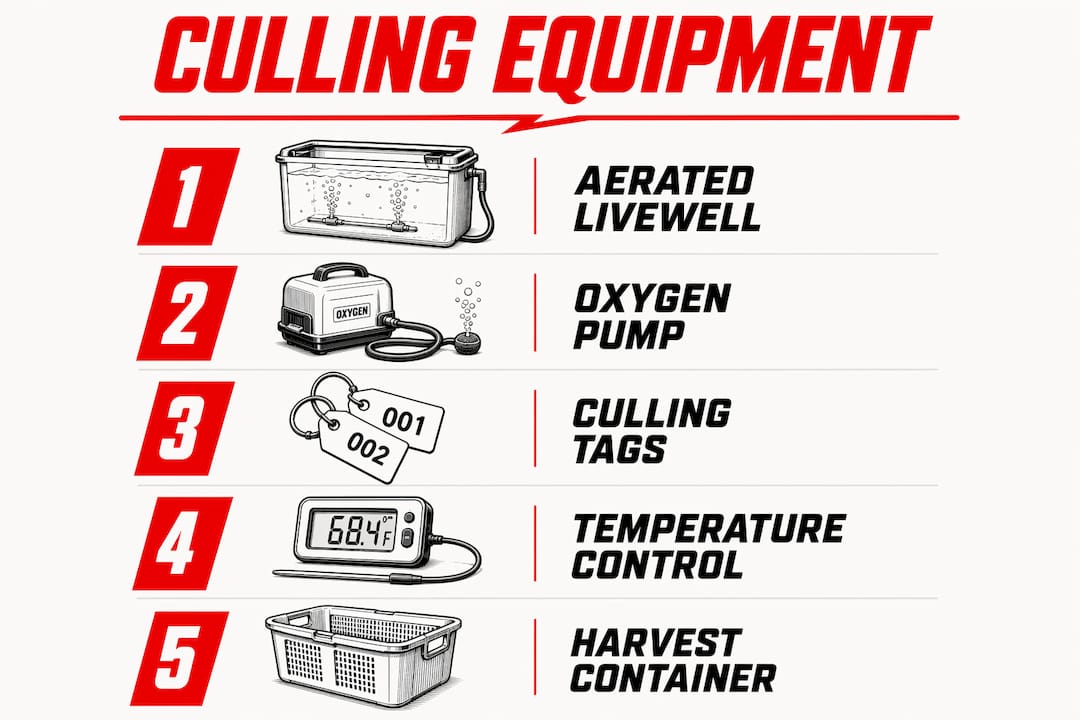
Tournament anglers treat livewell care as a continuous system involving oxygenation, temperature control, and water chemistry rather than a reactive fix when fish show stress. That mindset shift alone improves fish survival at weigh-in.
How do you cull bass safely step by step?
Culling done right is a fast, deliberate process. Rushing it or skipping steps costs you fish health and, in tournaments, it can cost you the win. Here is the sequence that works.
- Tag every fish immediately at landing. Clip a culling tag to the lower lip as soon as the fish enters the livewell. Note its weight on the tag or your culling beam. This gives you a real-time picture of your five-fish limit at all times.
- Monitor livewell conditions continuously. Check water temperature and aeration every 30 minutes. Refill with lake water if temperature climbs, and add dechlorinated ice if it exceeds 84°F. Do not wait for fish to roll before acting.
- Vent deep-water catches before they enter the livewell. Use the side-fizzing technique with an 18-gauge needle inserted just behind the pectoral fin. A fish that cannot hold neutral buoyancy will die in the livewell regardless of water quality.
- Select the fish to cull by comparing weights. Pull the lightest-tagged fish and hold it next to your new catch. If the new fish is heavier, the swap is worth making. If weights are close, consider the health of both fish before deciding.
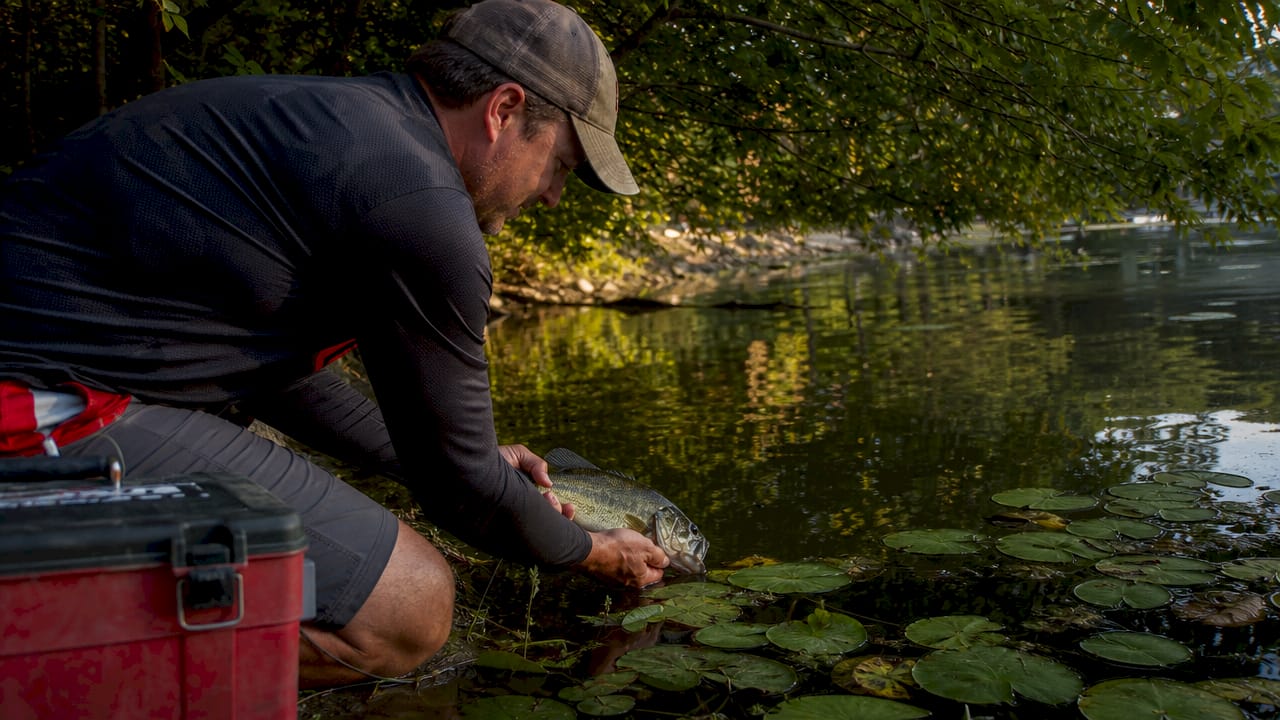
- Minimize handling time during the swap. Wet your hands before touching any fish. Keep the culled fish in the water as long as possible during the exchange. Release the culled fish immediately and gently, pointing it toward deeper water.
- Record the new weight on the replaced tag. Update your culling beam or tag notes right away. Accurate records prevent confusion later in the day when fatigue sets in.
- Know your jurisdiction’s dead-fish rules. Major tournament circuits assess a 4-ounce penalty for each dead fish at weigh-in. Some states, including Minnesota and Wisconsin border waters, prohibit culling dead fish entirely. Check local rules before every event.
Pro Tip: Organize your culling beam by weight from lightest to heaviest before the tournament starts. When you land a new fish, you only need to compare it against the lightest clip. This saves 10–15 seconds per decision, which adds up across a full day on the water.
Culling in a private pond follows a different sequence. There is no livewell involved. You simply harvest the fish you select and release the rest. The goal shifts from maximizing weight to improving population structure over time.
What mistakes and legal pitfalls should you avoid when culling bass?
Culling errors fall into two categories: fish welfare mistakes and legal violations. Both carry real consequences.
Common fish welfare mistakes
- Ignoring livewell temperature until fish show stress. By the time a bass rolls belly-up, the damage is done. Proactive temperature management is the only approach that works.
- Using municipal ice. Chlorine in tap-water ice harms gills directly. The damage is invisible until fish start dying hours later.
- Mixing salt additives with oxygenators. This produces chlorine gas in the livewell. The result is a dead limit before you reach the weigh-in line.
- Skipping barotrauma venting. A bass caught from 20 feet or deeper with a distended belly will not survive without venting. Releasing it unvented is a waste of a healthy fish.
- Over-handling during culling swaps. Every second a fish spends out of water adds stress. Keep swaps under 10 seconds whenever possible.
Legal violations that end tournaments and carry penalties
Culling is a legally granted privilege, not a right. Outside of permitted tournament contexts, replacing a caught fish with a larger one is classified as high-grading, which is illegal in most states. Recreational anglers who cull fish outside of a sanctioned event risk fines, license suspension, and seizure of equipment.
Dead fish at weigh-in cost you 4 ounces per fish under major circuit rules. In some jurisdictions, possessing a dead fish in your livewell after culling it is itself a violation. Read the tournament rules and your state’s fish and wildlife regulations before you launch. Ignorance of the rule is not a defense that tournament directors or conservation officers accept.
Anglers fishing near tournament disqualification territory should pay special attention to possession limits and culling windows. Some circuits close culling after a set time before weigh-in. Missing that window with a dead fish in the well is an avoidable loss.
How does selective culling improve pond health over time?
Pond culling is one of the most effective tools a private water manager has. The goal is not to catch the biggest fish. The goal is to remove the right fish to let the whole population grow stronger.
Overpopulated ponds fill up with stunted bass that compete fiercely for limited forage. Selective harvesting of smaller bass reduces that competition and leads to greater average fish sizes across the pond. The effect compounds year over year when you stick to a consistent harvest plan.
Fishery managers recommend harvesting about 30% of bass biomass annually and maintaining approximately 15 bluegill per bass harvested to support healthy predator-prey ratios. That ratio keeps the forage base strong enough to fuel bass growth without crashing the bluegill population.
| Culling strategy | Effect on pond health |
|---|---|
| No harvest (full catch-and-release) | Stunted bass, overcrowding, poor average size |
| Selective removal of small bass | Reduced competition, improved average size over time |
| 30% annual biomass harvest | Balanced predator-prey ratio, sustained forage base |
| Slot size protection (releasing large fish) | Preserves trophy-class genetics and spawning stock |
| Stocking after harvest | Restores forage base and maintains population structure |
Slot size protection pairs well with selective culling. Keeping bass below the slot and releasing fish above it protects your largest, most productive spawners. Over three to five years, a well-managed pond with consistent culling produces noticeably larger average fish than one managed with pure catch-and-release.
Pro Tip: Keep a simple harvest log for your pond. Record the date, number of fish removed, and estimated total weight. Comparing logs year over year tells you whether your culling plan is working or needs adjustment.
Understanding how fish stocking interacts with your culling plan helps you avoid over-harvesting. Stocking bluegill after a heavy bass cull restores the forage base and keeps the system balanced.
Key Takeaways
Proper bass culling requires proactive livewell management, legal awareness, and a consistent harvest plan to protect fish welfare and improve both tournament results and long-term fishery health.
| Point | Details |
|---|---|
| Livewell conditions are non-negotiable | Keep water below 84°F and dissolved oxygen above 5.5 ppm at all times. |
| Culling is a legal privilege | Outside sanctioned tournaments, replacing caught fish is illegal high-grading in most states. |
| Dead fish carry a 4-ounce penalty | Major circuits penalize each dead fish at weigh-in; some states prohibit culling dead fish entirely. |
| Pond culling builds better fisheries | Harvesting 30% of bass biomass annually and maintaining a 15:1 bluegill-to-bass ratio supports long-term growth. |
| Minimize handling during every swap | Wet hands, fast transfers, and immediate release of culled fish reduce stress and improve survival rates. |
What I’ve learned from years of watching anglers get culling wrong
The biggest mistake I see is treating culling as a single decision rather than a system. Anglers focus on the moment of the swap and ignore everything that happens before and after. By the time they pull a fish to compare weights, the livewell water is already 88°F and the oxygen is dropping. The swap itself becomes irrelevant because the fish they are keeping are already compromised.
The second thing I have noticed is that legal awareness is shockingly low. Anglers who fish tournaments regularly know the 4-ounce dead fish penalty. But ask them about high-grading laws outside of tournaments, or about Minnesota and Wisconsin border water rules, and most go quiet. Tournament preparation should always include a rules review specific to the water you are fishing, not just the circuit’s general rulebook.
For pond managers, the lesson I keep coming back to is patience. Culling a pond correctly takes three to five years to show dramatic results. Anglers who harvest aggressively in year one and then stop because they do not see immediate improvement are the ones who never get the fishery they want. Consistency beats intensity every time.
The anglers who do this well treat fish care as a discipline, not a chore. They check their livewell before they launch. They know their water temperature before they make their first cast. They have their venting needle ready before they need it. That level of preparation is what separates a good day from a great one, and a great tournament from a winning one.
— Mark
Bassanglermag has the resources to take your culling game further
Whether you are prepping for your first tournament or managing a private pond, Bassanglermag delivers the depth of content that makes a real difference on the water.

The Bass Angler Magazine 2025 Winter Issue is packed with tournament fish care breakdowns, livewell management techniques, and expert advice from anglers who compete at the highest levels. You will find content that goes well beyond the basics, covering the exact scenarios where culling decisions get complicated. The BAM Trail tournament circuit also gives you a community of anglers who take fish welfare seriously and compete with the same passion you bring to the water. Come fish with us.
FAQ
What is bass culling?
Bass culling is the practice of selectively replacing a smaller or less desirable fish in your livewell with a larger, healthier catch to improve your tournament weight or a pond’s population balance.
Is culling bass legal outside of tournaments?
Culling outside of a sanctioned tournament is classified as high-grading and is illegal in most states. It is a legally granted privilege that requires special tournament permits to perform lawfully.
What is the penalty for a dead fish at weigh-in?
Major tournament circuits assess a 4-ounce penalty for each dead fish presented at weigh-in. Some jurisdictions, including Minnesota and Wisconsin border waters, prohibit culling dead fish entirely.
What livewell conditions do bass need to survive?
Livewell water should stay 5–10°F below ambient lake temperature, with dissolved oxygen above 5.5 ppm. Temperatures above 84°F cause thermal stress that kills fish quickly.
How much should you harvest from a bass pond annually?
Fishery managers recommend harvesting about 30% of bass biomass annually and maintaining approximately 15 bluegill per bass harvested to keep predator-prey ratios balanced and support long-term fish growth.