
Spinning reels are everywhere in bass fishing, but most anglers never stop to understand how they actually work. That misunderstanding quietly kills casting distance, creates frustrating line tangles, and costs fish at the worst possible moments, like weigh-in at a tournament. Understanding how spinning reels work for bass fishing is not about being a gear nerd. It is about removing the problems that slow you down and replacing them with confidence every time you pick up the rod.
Table of Contents
- How spinning reels mechanically operate for bass fishing
- The importance of correct spooling: preventing line twist and birds nests
- Choosing the right spinning reel size and line for bass fishing
- Understanding and setting drag for smooth bass fights
- Why mastering spinning reel setup details separates tournament pros from amateurs
- Explore more bass fishing tips and gear at Bass Angler Magazine
- Frequently asked questions
Key Takeaways
| Point | Details |
|---|---|
| Spinning reel mechanics | A spinning reel’s stationary spool and rotating bail enable easy, smooth casting and retrieval suitable for bass fishing. |
| Correct spooling | Proper line orientation and spool fill prevent line twist and tangles, improving casting performance. |
| Right reel size | Choose a 2500 or 3000 size spinning reel based on line weight and lure size for optimal bass fishing. |
| Drag setting | Set drag to about one-third of line strength to balance fish control and line safety. |
| Attention to detail | Small setup details like spool fill and drag adjustments significantly impact tournament bass fishing success. |
How spinning reels mechanically operate for bass fishing
The smartest place to start is the spool itself. Unlike a baitcasting reel where the spool spins during a cast, a spinning reel is built differently. The spool stays stationary during the cast, and line simply peels off the front of it in loops. When you open the bail arm and make your forward cast, nothing is spinning except the line as it flows off. This is exactly why spinning reels are so forgiving and why a beginner can pick one up and start casting in minutes.
When you turn the handle after the cast, the bail closes and the line roller begins winding line back onto the stationary spool. The rotor (the arm assembly that holds the bail) rotates around the spool. The spool itself actually moves up and down slightly to distribute line evenly. That combination of rotating rotor and oscillating spool is what keeps your line neat and ready for the next cast.
What makes this design so effective for bass fishing:
- No spool rotation means no backlash, which is the main frustration with baitcasting reels for newer anglers
- Lighter lures under 1/2 ounce cast effortlessly because there is no spool inertia to overcome
- Finesse presentations like drop shots, shaky heads, and ned rigs are far easier to control
- One-handed operation lets you manage slack line and rod position at the same time
Pro Tip: The moment you feel your bail dragging or sticking mid-retrieve, clean and lubricate the bail spring. A sticky bail is one of the top causes of mid-fight line breaks and missed hook sets. For heavier presentations, check our casting reel recommendations to know when a baitcaster is the better call.
The importance of correct spooling: preventing line twist and birds nests
This is where most spinning reel problems actually start. Not with the reel. Not with the line. With the spooling process. Correct spooling direction is specifically designed to minimize line twist, birds nests, and knots before they ever happen.
Here is the core problem. Your bail lays line onto the spool by rotating in one direction. The line coming off your supply spool also comes off in a rotational direction. If those two directions oppose each other, the line fights itself every single cast. You will see it as those aggravating corkscrew loops and tangles. Flipping the supply spool the wrong way feeds opposing rotation directly into every foot of line you spool up.
“Most line twist complaints result from rotational direction mismatch between supply spool and bail, not from reel defects.”
How to spool your spinning reel correctly, step by step:
- Tie your line to the spool arbor with an arbor knot and trim the tag end short
- Lay the supply spool flat on the floor with the label facing up
- Run the line through the first guide on your rod before engaging the bail
- Close the bail and begin reeling slowly while applying light tension with your fingers
- After 10 to 15 turns, let the line go slack and watch for corkscrew loops or twists
- If you see twisting, flip the supply spool over and continue from the other side
- Stop filling when the line sits 1/8 to 1/16 inch from the spool rim
That last point matters more than people realize. Overfilling is one of the most common causes of birds nests. When you have too much line on the spool, it balloons off in uncontrolled loops during the cast instead of flowing cleanly. If you find yourself dealing with repeated tangles, check out common spinning reel problems and how to fix them fast before your next trip.
Pro Tip: Use a pencil or pen through the center of the supply spool and have a buddy hold it while you spool up. It keeps consistent tension and holds the spool perfectly still, which makes a measurable difference in how cleanly the line lays.
Choosing the right spinning reel size and line for bass fishing
Spinning reel sizes are labeled by a numbering system, typically 1000 through 5000 for bass fishing applications. The number reflects the spool size, line capacity, and overall reel body size. For bass, a 2500 to 3000 size spinning reel covers the vast majority of situations you will encounter.
| Reel size | Best application | Ideal line weight | Lure range |
|---|---|---|---|
| 2500 | Finesse fishing, drop shot, ned rig | 8 to 10 lb | 1/16 to 1/4 oz |
| 3000 | All-purpose bass, wacky rig, light swimbaits | 10 to 12 lb | 1/4 to 1/2 oz |
| 4000 | Bigger baits, frog, heavier cover | 12 to 17 lb braid | 1/2 oz and above |
Beyond size, your line choice for bass fishing plays a big role in how the reel performs on the water.
Line types and what they bring to spinning reel fishing:
- Monofilament: Stretchy and forgiving, great for treble hook presentations where flex helps keep fish pinned. Spools easily and casts smoothly
- Fluorocarbon: Low stretch, nearly invisible underwater, and sinks faster than mono. Ideal for finesse bass fishing where sensitivity matters
- Braid: Zero stretch and incredibly sensitive. Works well as a main line on spinning reels when paired with a fluorocarbon leader for clear water situations
A well-matched rod and reel pairing amplifies everything. A 2500 reel on a medium-light 7-foot spinning rod is one of the most versatile setups in bass fishing. It casts small lures a country mile and handles most finesse presentations without breaking a sweat.
Understanding and setting drag for smooth bass fights
Drag is the mechanism inside your reel that allows line to slip under controlled tension when a fish pulls hard enough. Think of it as a safety valve. Without drag, a big bass would snap your line the moment it surged. With drag set correctly, the fish pulls line out against steady resistance while you maintain control.
How to set your drag for bass fishing:
- Start by pulling line directly off the spool by hand to feel the resistance
- Set drag to about one-third of your line’s breaking strength before you start fishing
- For 10 lb fluorocarbon, that means roughly 3 to 3.5 pounds of pull before line slips
- Check drag before every outing. Heat, cold, and use affect how drag washers perform
- During a fight with a big fish, back your drag off slightly if the fish is running toward a structure where a break could occur
The drag knob is at the top of most spinning reels (called a front drag) or at the rear of the reel body (rear drag). Front drag systems are generally more reliable and offer smoother pressure. Tournament anglers almost universally prefer front drag spinning reels for exactly that reason.
Pro Tip: Never tighten your drag all the way and then slam the rod back hard on a hook set. That combination creates a sudden spike in tension that exceeds your drag setting for a split second, which is exactly when lines break. Set your hook with a firm, quick motion and let the drag do the rest.
Why mastering spinning reel setup details separates tournament pros from amateurs
Here is something most fishing articles skip right over. The difference between a tournament angler who lands 90 percent of their fish and one who loses important bass at the boat is rarely about rod skill or lure selection. It almost always comes down to setup details they checked before the day started.
Small spooling errors create cascading problems. A slight line twist from incorrectly oriented spooling does not just cause one tangle. It compounds with every cast. By mid-morning you are losing casting distance, dealing with loops at the tip guide, and fighting your own gear when you should be focused on reading the water. Tournament performance depends on removing those friction points before they exist.
Many anglers blame the reel. They assume the reel is defective or cheap. But correct spool fill height and line lay are setup details that matter immediately in the field, and they cost nothing to get right. We have watched anglers at BAM events struggle all day with birds nests that would have been solved in two minutes with a correctly oriented supply spool.
Tournament pros treat drag settings like tire pressure. They check it every single day, not just at the start of the season. Water temperature changes line performance. A 10 lb fluorocarbon behaves differently on a cold spring morning than it does during a hot July afternoon. Anglers who adjust for those changes land bigger bass. Anglers who ignore it hand fish to their competition.
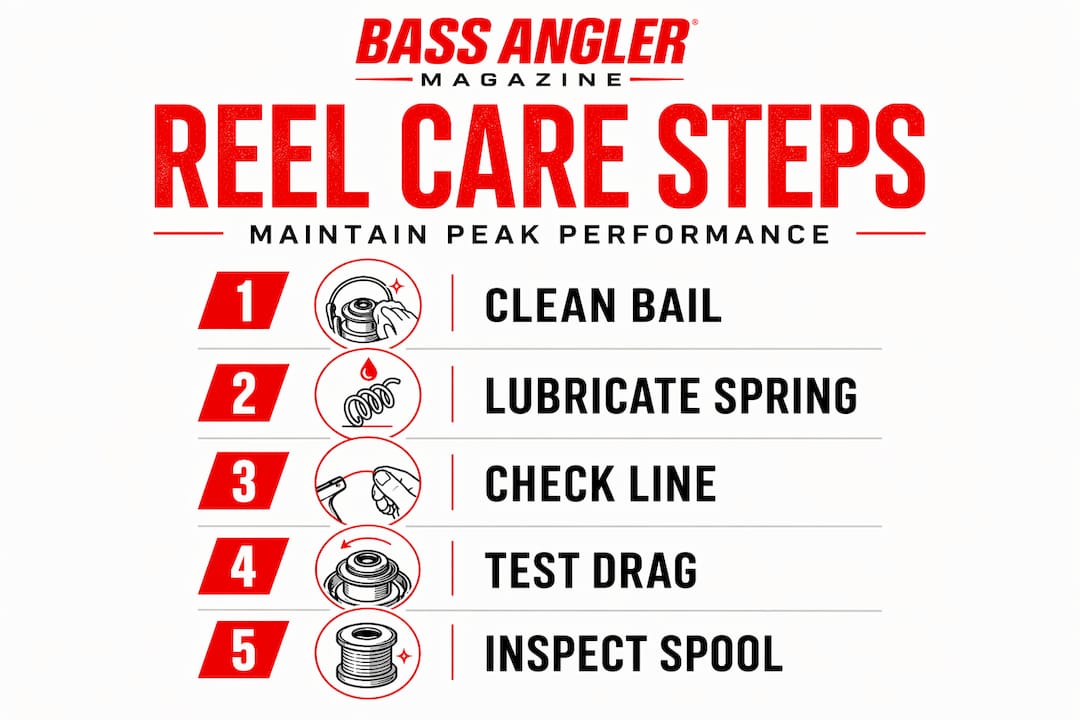
The practical fix is building a five-minute pre-launch routine: check line for twists, verify spool fill, test drag pressure, inspect the bail roller for wear. Those five minutes are worth more than an extra $200 rod. If you want to go deeper on fixing specific gear issues fast, spinning reel troubleshooting tips are a great next step.
Explore more bass fishing tips and gear at Bass Angler Magazine
You have got the mechanics down. Now it is time to put that knowledge to work on the water.

At Bass Angler Magazine, we are built for anglers who want to keep improving. Whether you are chasing your first tournament win or just tired of losing good fish at the net, our library of expert tips, gear reviews, and technique breakdowns is here for you all year long. Discover strategies for every bass fishing situation, from kayak bass trolling to fishing heavy vegetation with confidence. Our community of passionate bass anglers grows every season, and there is always something new to learn. Head over to Bass Angler Magazine and explore everything we have waiting for you.
Frequently asked questions
What causes line twists on spinning reels when bass fishing?
Line twists are almost always caused by incorrect spooling orientation where the supply spool rotation opposes the bail’s winding direction, not by a defective reel. Flipping the supply spool over during the spooling process usually solves the problem immediately.
How full should I fill my spinning reel spool for bass fishing?
Fill the spool to about 1/8 to 1/16 inch from the rim. Overfilling causes ballooning and the kind of catastrophic birds nests that ruin a morning of tournament fishing.
What reel size and line weight is best for bass fishing with spinning reels?
A 2500 size reel works best for finesse presentations with 8 to 10 lb line, while a 3000 size handles heavier 10 to 12 lb lines and bigger lures with more comfort and control.
How should I set my drag for bass fishing?
Set drag to one-third of your line’s breaking strength before you hit the water. For 10 lb line, that is roughly 3 to 3.5 pounds of resistance before the line slips, which gives you a solid balance of power and protection against break-offs.