
Bass are opportunistic, energy-optimizing predators that use ambush and active pursuit depending on water temperature, light, cover, and prey availability. Understanding how bass feeding behavior works gives you a direct edge: before your next trip, check water temperature and identify the dominant forage, then choose a lure profile and presentation speed that matches both. That single habit separates anglers who grind through a tough day from those who put fish in the boat consistently.
Table of Contents
- How bass feeding behavior works: ambush versus active strikes
- What do bass actually eat?
- When do bass feed? Daily patterns and temperature windows
- Where do bass feed? Structure, cover, and comfort zones
- How do environmental factors shift bass feeding behavior?
- How can you tell what bass are feeding on?
- Fishing tactics tied to bass feeding behavior
- What does fisheries science say about bass feeding?
- Key Takeaways
- Reading the water: one angler’s perspective
- Bassanglermag: your next step on the water
- Selected further reading and authoritative sources
How bass feeding behavior works: ambush versus active strikes
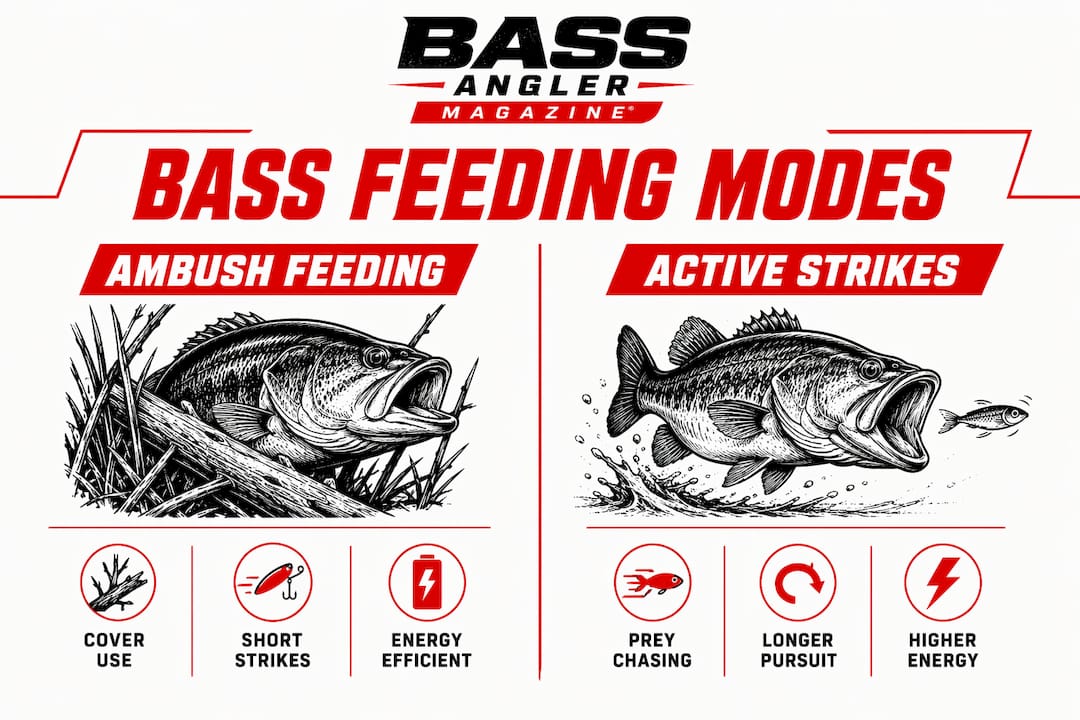
Bass operate on a simple biological contract. They want the most calories for the least effort. That drives two distinct feeding modes you will encounter on any body of water.
Ambush feeding is the default. Bass tuck into cover, shade, or structure and wait for prey to pass within short striking range. When it does, they fire a suction strike. Research published in PNAS confirms that this strike is powered primarily by the axial body muscles (the epaxial and hypaxial groups), which can contribute up to 95% of the total power during a feeding event. The buccal cavity expands rapidly, creating a suction jet that draws prey into the mouth.
Active pursuit happens when the caloric math tips in favor of chasing. Warmer water, abundant baitfish schools, and post-frontal recovery periods all push bass into open-water pursuit mode. They cover more ground, hit faster-moving baits, and are far easier to locate.
Here is what makes the mechanics so important for hookset timing:
- The suction strike completes in 30–50 milliseconds, far faster than human visual or tactile reaction time.
- What you feel on the rod is the retention phase, not the initial intake. The fish has already evaluated and begun rejecting the bait by the time your hand registers the tap.
- Setting the hook on feel, not on anticipation, is the practical takeaway from the biomechanics.
Stat to know: Axial body muscles supply the majority of the power behind a bass suction strike, making it one of the fastest predatory events among freshwater fish.
What do bass actually eat?
Bass eat a wider range of prey than most anglers realize, and knowing the full menu helps you pick the right lure profile for your lake.
The core forage groups are baitfish (shad, minnows, and smelt), crayfish, sunfish and bluegill, frogs and other amphibians, and insects. Regional forage composition shifts significantly: shad dominate many southern reservoirs, while goby, yellow perch, and smelt are the primary targets in northern fisheries. Knowing your lake’s dominant baitfish is the first step toward matching lure profile and color. For a deeper look at how shad and minnows shape bass diet, Bassanglermag’s guide on baitfish in bass diet is worth bookmarking.
Less obvious but consequential prey includes mice, ducklings, snakes, and large frogs. Bass will eat just about anything they can fit in their mouth, which explains why walking baits, hollow-body frogs, and large surface lures produce some of the most explosive strikes you will ever see.
Prey size follows a documented biological limit. Studies show bass can consume prey up to roughly 60% of their own body length, and they will attempt larger meals when the caloric payoff justifies the effort. For anglers targeting big fish, this means upsizing your swimbait or jig trailer is not just a confidence move. It is biologically sound.
Stat to know: Bass can take prey approaching a large fraction of their own body length, which means a medium-sized bass can realistically target large baitfish.
When do bass feed? Daily patterns and temperature windows
Water temperature is the master factor controlling bass metabolism. Everything else, from retrieve speed to lure choice, flows from it.
Daily feeding rhythm
Bass follow a predictable daily arc across most seasons:
- Early morning: Shallow feeding as water warms from overnight lows. Bass push onto flats, points, and shallow cover to intercept baitfish doing the same.
- Mid-day: Retreat to shade, deeper structure, or thermoclines as surface temps climb and light penetration increases. Feeding slows but does not stop.
- Evening: A second shallow push as light fades and surface temps begin dropping. Often the most aggressive feeding window of the day in summer.
Temperature thresholds that change everything
| Temperature Range | Bass Behavior | Tactical Adjustment |
|---|---|---|
| — | Sluggish, minimal feeding | Slow finesse presentations, small profiles |
| — | Increasing activity, cautious | Slow-rolled swimbaits, drop shots |
| 60°F–80°F | Peak aggressive feeding | Full lure rotation, faster retrieves |
| Above 80°F | Seek cooler/deeper water, reduced feeding | Deep structure, current seams, early/late only |
Field & Stream’s temperature guidance and BassForecast’s metabolism research both point to the 60°F–80°F band as the sweet spot for aggressive feeding. Outside that window, bass are still catchable, but the presentation must match their metabolic state.
The 80/20 rule applies directly here. Roughly 80% of your bites will come from the 20% of conditions and locations where temperature, oxygen, and forage align. Prioritize trending temperatures over static ones: a lake warming from 58°F to 63°F will fish far better than one sitting at a stable 65°F, because bass respond to the direction of change, not just the number. For fall-specific tactics tied to these temperature swings, check out Bassanglermag’s fall bass tips.
Stat to know: Bass feed most aggressively in moderate water temperatures; feeding slows noticeably in colder and hotter conditions.
Where do bass feed? Structure, cover, and comfort zones
Bass do not roam randomly. They position themselves where food, cover, and oxygen overlap, and they relocate the moment one of those three elements becomes limiting.
Common feeding spots include vegetation edges, submerged timber, docks, rock and rip-rap banks, points, and current seams. Each offers a combination of ambush opportunity and prey concentration. BassResource’s foundational biology overview frames it clearly: a bass needs food, oxygen, and cover to survive, and it will not stay anywhere that lacks one of them.
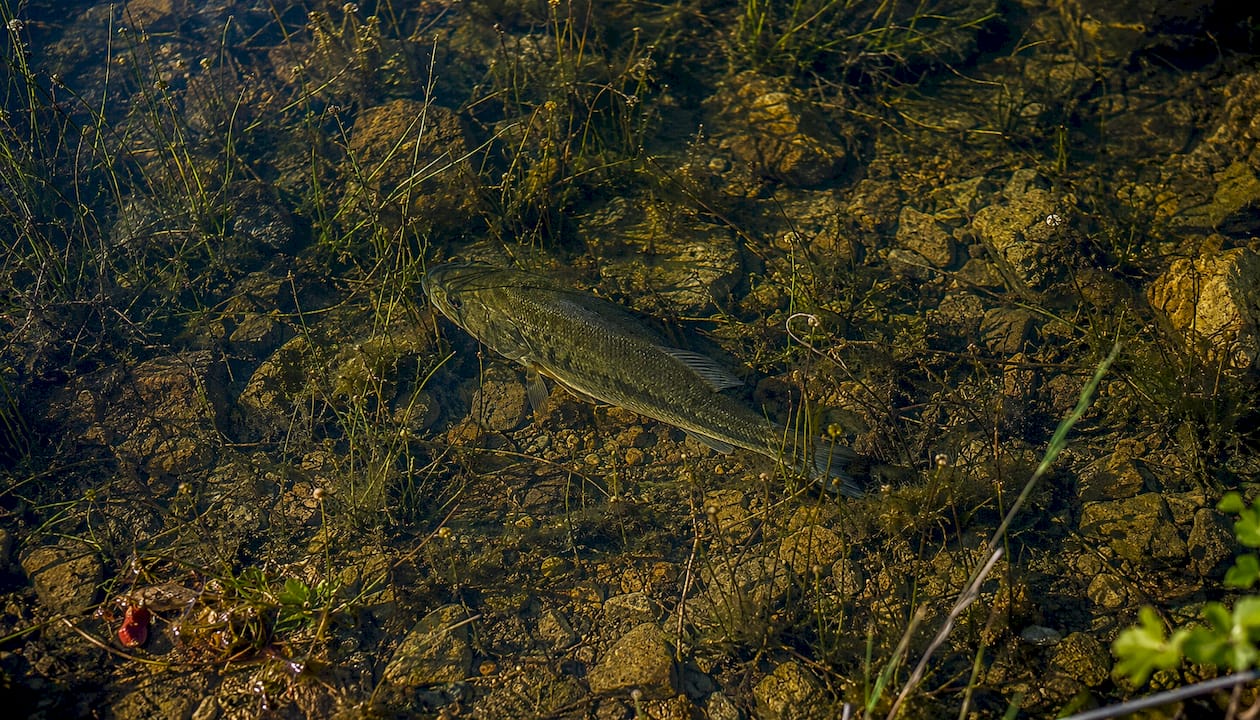
The comfort zone concept matters most during thermal extremes. In summer, when shallow water exceeds 80°F and oxygen levels drop, bass move to current seams, deeper structure, or vegetated pockets where aquatic plants replenish dissolved oxygen. Fishing the obvious shallow cover during a heat wave often means fishing empty water.
Pro Tip: Target transition edges, the seam where vegetation meets open water, a dock edge where shade meets sunlit bottom, or a point where a flat drops into depth. These edges concentrate both prey and bass far more reliably than the thickest cover alone.
For anglers who want to go deeper on vegetation-specific tactics, Brandon Palaniuk’s approach to fishing vegetation for bass is a great next read.
How do environmental factors shift bass feeding behavior?
Small changes in light, wind, and barometric pressure can flip bass from lockjaw to feeding frenzy in minutes. Knowing which triggers to watch for is what separates reactive anglers from proactive ones.
- Light and water clarity: In clear water under bright sun, bass rely heavily on vision. They respond to realistic profiles, natural colors, and precise lure placement. In murky or stained water, vision degrades and bass shift to lateral line detection, picking up vibration and pressure waves. Switching to a rattling crankbait or a chatterbait in low-visibility conditions is not a guess; it is matching the fish’s active sensory channel.
- Barometric pressure: Feeding windows often open on falling pressure, particularly on the leading edge of a cold front when bass go on a pre-storm binge. Once a high-pressure system locks in, especially after a cold front passes, bass tighten up and move deeper or tuck tighter into cover. Slow down and downsize on those bluebird days.
- Oxygen and turbidity: Warm, shallow, still water loses dissolved oxygen quickly. Bass in these conditions become lethargic and move to oxygenated current seams or vegetated areas. Turbid water from runoff or wind-driven chop can concentrate bass along cleaner-water edges where visibility and oxygen are both better.
- Wind: Wind-driven current pushes baitfish and creates feeding opportunities along windward banks and points. Bass stack on the downwind side of structure to intercept disoriented prey.
How can you tell what bass are feeding on?
Reading the water before you make your first cast saves hours of guessing. These field signs give you a fast, reliable picture of what bass are eating right now.
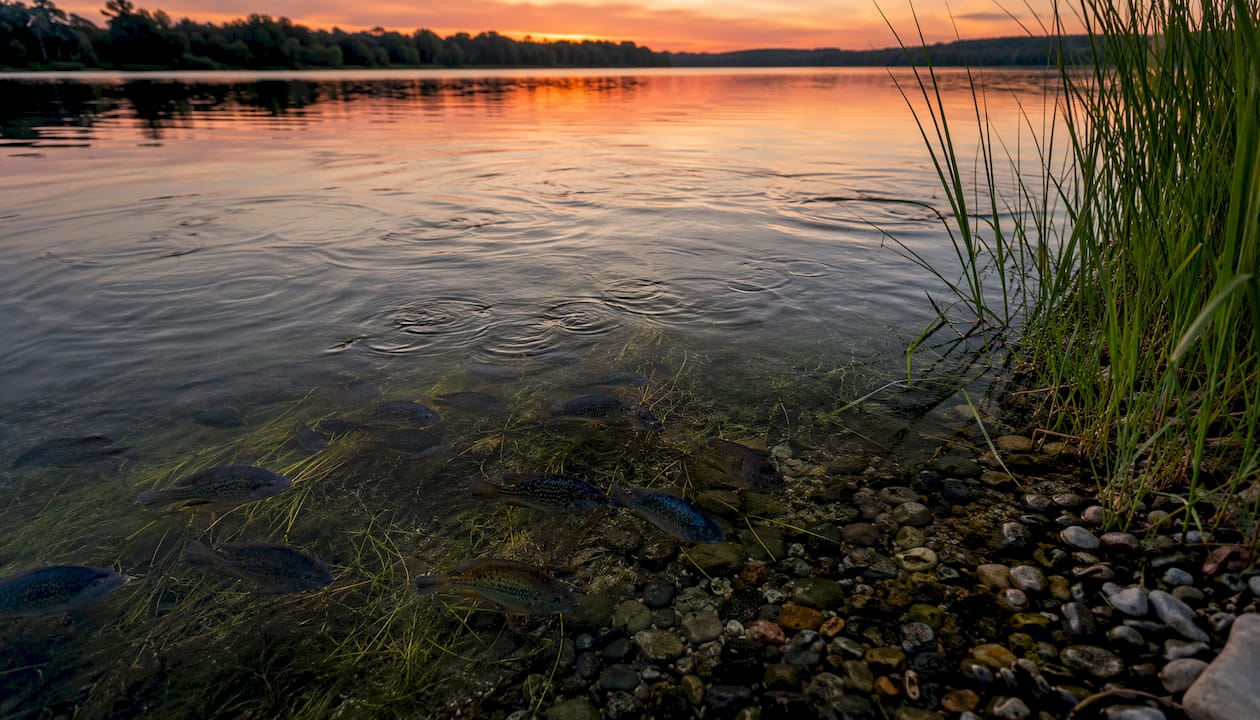
Surface and visual signs: Baitfish dimpling the surface, shad flipping near the bank, or bluegill schooling in shallow cover all point to active forage. When bass are pushing bait to the surface, you will see the water erupt. That is your cue to go topwater immediately.
Bird and angler activity: Diving birds, especially herons working a shoreline or gulls circling a point, mark active baitfish concentrations. Other anglers catching fish on a specific bait pattern are equally useful data.
On-fish clues: When you land a bass, check the throat and gill area for crushed crayfish shells, tail fragments, or baitfish scales. These traces tell you exactly what the fish ate last, often more reliably than any surface observation.
Pro Tip: If you keep a fish where regulations allow, a quick look at stomach contents is the most accurate forage check available. If you practice catch-and-release, which Bassanglermag strongly encourages, the throat and gill traces on a gently handled fish give you nearly the same information without any harm to the fish.
Ethical handling matters here. Minimize air exposure, support the fish horizontally, and return it quickly. The bass you release today is the trophy someone else, maybe you, catches next season.
Fishing tactics tied to bass feeding behavior
Turn everything above into a repeatable pre-launch checklist and you will make better decisions from the first cast.
Match the sensory mode
- Clear water, bright light: Swimbaits, soft plastic stick baits, and natural-colored crankbaits. Realistic profile and precise placement matter most.
- Murky or low-light conditions: Spinnerbaits, chatterbaits, and bladed jigs with rattles. High contrast colors (black/blue, white/chartreuse) and vibration do the work that vision cannot.
- Scent as a backup: When both vision and vibration fail, scent-enhanced soft plastics can trigger strikes from bass holding tight to cover. Bassanglermag’s guide on scent in bass fishing covers this in detail.
Match lure inhalability to metabolic state
Cold water slows everything, including the suction strike. Heavier, high-specific-gravity baits are harder for bass to accelerate into their mouth during a suction strike, which increases short strikes and misses. In cold water or when bass are sluggish, lighter profiles, finesse worms, small swimbaits, and drop-shot rigs connect more reliably because they require less suction force to inhale fully.
The 80/20 pre-launch checklist
- Check water temperature and note whether it is rising or falling.
- Confirm the dominant forage for your lake (shad, crayfish, bluegill, or regional baitfish).
- Select lure profile and size to match that forage, upsizing when targeting big fish.
- Choose retrieve speed to match metabolic state: slow and deliberate in cold or post-frontal conditions, faster and more aggressive in the feeding window.
- Focus first on transition zones, edges where cover meets open water, shade meets sun, or shallow meets deep.
Pro Tip: Pattern fishing in tournaments follows this same logic at scale. The anglers who win are not fishing the most water; they are fishing the right 20% of it. For more on how that works competitively, Bassanglermag’s breakdown of pattern fishing in bass tournaments is a great resource.
What does fisheries science say about bass feeding?
The biology behind bass feeding behavior is well-documented, and the research translates directly into better angling decisions.
The PNAS study on suction feeding mechanics established that axial body muscles, not the smaller cranial muscles, supply the majority of power during a bass strike. This finding reframed how scientists and anglers think about the strike: it is a whole-body event, not just a jaw snap. The speed and force generated explain why bass can inhale prey from several inches away without physically touching it first.
A separate study on prey-size limits documented the roughly 60% body-length consumption threshold, confirming that bass actively select prey size based on caloric return. Bigger bass target bigger prey not out of aggression but out of energy efficiency.
Sensory adaptability is equally well-supported. Research on largemouth bass sensory deprivation showed that when visual cues are removed, bass shift toward suction-based capture and rely on lateral line detection to locate prey. This is why switching to vibration-heavy or scent-enhanced baits in low-visibility conditions is not just a hunch; it is backed by controlled laboratory observation.
For anglers, the translation is straightforward: match your lure’s profile and density to the fish’s current sensory mode and metabolic state, and you will get more complete hookups with fewer short strikes.
Key Takeaways
Bass feeding behavior is driven by energy optimization, which means temperature, forage, cover, and sensory conditions determine where bass are, what they eat, and how hard they hit.
| Point | Details |
|---|---|
| Temperature controls everything | Bass feed most aggressively between 60°F and 80°F; adjust presentation speed and lure size outside this range. |
| Strike speed demands patience | The suction strike completes in 30–50 ms; set the hook on feel during the retention phase, not on anticipation. |
| Prey size guides lure choice | Bass can consume prey up to 60% of their body length; upsize lures when targeting big fish in forage-rich water. |
| Sensory mode shifts with conditions | Clear water favors visual baits; murky or dark water demands vibration, contrast, and scent to trigger strikes. |
| Bassanglermag resources | Bassanglermag covers bass biology, seasonal tactics, and tournament insights across articles, podcasts, and the BAM Trail. |
Reading the water: one angler’s perspective
There is a moment on the water that every experienced bass angler knows. You have been grinding through mid-morning with a reaction bait, picking up a fish here and there, and then the bite just goes quiet. The instinct is to keep throwing the same thing harder. The better move is to stop and read what changed.
On a late-spring morning, the right call is often to watch the water for two minutes before retying. If the baitfish that were dimpling the surface near the dock edge have disappeared, the bass that were chasing them have likely dropped down. That is the moment to switch from a topwater to a drop-shot or a shaky head, slow everything down, and work the base of the dock rather than the surface. The fish did not leave. They just changed depth and mood.
What the science in this article confirms is that those adjustments are not guesswork. Temperature trending upward, baitfish moving deeper, light angle increasing: each one shifts the bass’s sensory priority and energy budget in a predictable direction. When you understand the biology, you stop reacting to the bite shutting off and start anticipating it before it happens. That is the difference between a good day and a great one.
Bassanglermag: your next step on the water
Bassanglermag delivers the kind of biology-backed, field-tested bass fishing content that makes articles like this one possible year-round. Through Bass Angler Magazine, the BAM Tournament Trail, livestreams, podcasts, and television coverage, there is always something fresh to sharpen your approach, whether you are chasing your first five-pounder or competing for a tournament check.
If the feeding behavior concepts here sparked some questions about live-bait presentations, the live bait bass fishing setup guide on Bassanglermag walks through pro-level rigging and tactics in detail. For a broader dive into bass biology and underwater behavior, the underwater world of bass fishing feature is packed with multimedia content that brings the science to life. Head over to bassanglermag.com to explore the full library and find the content that fits where you are in your fishing right now.
Selected further reading and authoritative sources
These are the primary sources and reference pages that back the biology and tactics covered in this article.
- PNAS: How fish power suction feeding — foundational research on axial muscle power and suction strike mechanics in largemouth bass.
- DOI: Prey-size limits in bass — documents the roughly 60% body-length consumption threshold and caloric selection behavior.
- Field & Stream: What Do Bass Eat? — practical temperature guidance and forage overview for freshwater bass.
- BassForecast: Bass Metabolism and Water Temperature — detailed explanation of how temperature drives metabolism and feeding windows.
- BassResource: Understanding Bass Part I — angler-facing synthesis of food, oxygen, and cover as the three survival drivers.
- Outdoor Life: What Do Bass Eat? — regional forage breakdown and expert commentary on diet composition.
- ScienceDirect: Largemouth bass sensory deprivation study — controlled research on how bass switch between vision and lateral line feeding modes.
- Your state fish-and-wildlife agency website — for local regulations on keeping fish for stomach sampling, seasonal restrictions, and lake-specific forage surveys.
- Bassanglermag.com — articles, podcasts, BAM Trail event coverage, and seasonal tactics updated year-round.